An Adaptive Learning Framework for Educational Product Innovation
Tonye Kehinde Amabibi1*
1 Independent Researcher, Nigeria
*Corresponding author: amabibitonye@gmail.com
Abstract. Digital learning increasingly combines platforms, artificial intelligence, multiple content formats, and social distribution, yet these elements are often designed as separate tools. This paper develops a conceptual framework for educational product innovation that connects these elements into an adaptive learning ecosystem.
The study uses a conceptual synthesis approach. A focused synthesis of peer-reviewed literature and policy guidance on AI in education, adaptive learning, digital ecosystems, formative assessment, and social-media-supported learning was combined with a structured analysis of the framework and practical implementation examples documented in the author's 2026 monograph. The implementation examples are treated as illustrative cases rather than as an empirical evaluation.
The resulting framework identifies three interacting infrastructure layers, digital products and platforms, artificial intelligence, and social distribution, and seven linked design processes: defining the learning need, packaging knowledge, building an owned digital home, augmenting with AI, designing the attention path, creating feedback loops, and measuring, learning and iterating. The framework integrates access, personalisation, engagement, assessment, and continuous improvement within one architecture.
The framework offers a practical conceptual model for educators, learning designers, and education entrepreneurs developing technology-enabled learning experiences. It extends technology-centred approaches by treating distribution and feedback as integral parts of the learning ecosystem. Future research should empirically test the framework across educational settings and examine learner outcomes, equity, privacy, and sustainability.
Keywords: Educational product innovation; adaptive learning; artificial intelligence in education; digital learning ecosystems; formative assessment
1. Introduction
Digital education has moved beyond the simple conversion of classroom materials into electronic formats. Contemporary learning experiences may combine web platforms, mobile applications, multimedia content, artificial intelligence (AI), analytics, social interaction, and multiple distribution channels. Research on AI in education has identified adaptive systems, personalisation, assessment, prediction, and intelligent tutoring among the major application areas, while more recent reviews emphasise the growing use of AI for personalised and data-driven learning (Zawacki-Richter et al., 2019; Hariyanto et al., 2025).
At the same time, research on digital ecosystems suggests that AI produces educational value most effectively when it is embedded in an interconnected environment rather than treated as an isolated technology. Rojas and Chiappe (2024), for example, describe educational digital ecosystems in terms of interconnected networks, applications, services, and users, with personalisation emerging as an important focus. Research on adaptive learning similarly shows the development of systems that adjust learning content or pathways in response to learner information (Kabudi et al., 2021).
Another important dimension is how learners discover and enter digital learning environments. A systematic review of social media as a teaching and learning tool found substantial scholarly interest in social platforms, but also noted a need for stronger theoretical grounding of their pedagogical use (Perez et al., 2023). Quantitative research has further demonstrated that social-media engagement can be examined through behavioural measures such as posts, comments, views, and time-based indicators (Tarifa-Rodriguez et al., 2024). These findings suggest that distribution channels can form part of the learning architecture, provided that their use is connected to meaningful educational activity.
The author monograph, Educational Product Innovation, proposes an adaptive learning ecosystem in which digital products and platforms, AI, and social infrastructure operate as connected components. Its practical blueprint describes seven sequential but iterative activities: defining the learning need, packaging knowledge, building an owned digital home, augmenting with AI, designing the attention path, creating feedback loops, and measuring, learning and iterating. This paper adapts framework into a conceptual academic model and situates it within existing research (Amabibi, 2026). The article's contribution is to make the relationships among these components explicit and position the integrated framework in relation to selected educational technology literature.
The objective of this paper is therefore to answer the following question: How can digital products, AI, social distribution, and feedback mechanisms be integrated into a coherent framework for educational product innovation? This paper contributes a conceptual model intended to support the design and future empirical testing of adaptive learning ecosystems.
2. Research methodology
2.1 Research design
This study adopts a conceptual synthesis design. It does not report a survey, experiment, interview study, or statistical evaluation. Instead, it combines a focused synthesis of relevant literature with structured analysis of a pre-existing practitioner framework. This approach is appropriate because the primary output of the study is a conceptual model whose components and relationships require theoretical grounding before empirical testing.
The literature component focused on five areas directly related to the proposed framework: (1) AI in education and adaptive learning; (2) digital ecosystems in education; (3) formative assessment and AI-supported feedback; (4) social media and digital learning engagement; and (5) human-centred and responsible use of generative AI. Selected peer-reviewed review studies and established guidance documents were used to clarify recurring concepts, applications, opportunities, and risks. This was a focused conceptual literature synthesis, not a systematic review.
2.2 Source selection and synthesis
The synthesis drew on selected peer-reviewed literature and established guidance relevant to the framework's five focus areas. Sources were selected for their direct relevance to adaptive learning, AI-enabled learning systems, educational digital ecosystems, social-media-supported learning, AI-supported formative assessment, and responsible use of generative AI. The source set includes review and mapping studies and institutional guidance by Zawacki-Richter et al. (2019), Kabudi et al. (2021), Perez et al. (2023), Zhai and Nehm (2023), Rojas and Chiappe (2024), Tarifa-Rodriguez et al. (2024), Hariyanto et al. (2025), and UNESCO (2023). These sources were selected for conceptual relevance and identifiable publication details, not to create an exhaustive corpus or estimate an effect size.
The literature was examined through conceptual thematic mapping. Relevant concepts and relationships were mapped to the framework's three infrastructure layers, digital products and platforms, artificial intelligence, and social distribution, and its seven-stage design cycle. No predefined systematic-review protocol, exhaustive database search, record-counting procedure, or inter-rater screening was used.
The second component involved structured analysis of the author's 2026 monograph, Educational Product Innovation: Engineering Adaptive Learning Ecosystems Through Digital, AI, and Social Infrastructure. The analysis considered its definition of an adaptive learning ecosystem, three pillars, seven-step practitioner's blueprint, and documented examples of digital products, learning platforms, mobile applications, content distribution, and AI-enabled workflows. These examples illustrate practical context; they are not presented as evidence of causal learning effects (Amabibi, 2026).
2.3 Analytical procedure
The literature and the pre-existing practitioner framework were compared thematically. Concepts recurring in the selected literature were mapped to elements of the framework, and the resulting elements were arranged as an ecosystem in which infrastructure layers support a continuous learning cycle. The framework was checked for internal coherence against the study objective and the journal's focus on digital education, AI, innovative learning methodologies, and lifelong learning. No human participants or identifiable personal data were involved. The principal methodological limitation is that this is a focused conceptual synthesis rather than a systematic review.
3. Results
The synthesis produced a framework with three interacting infrastructure layers and seven linked design processes. The central proposition is that educational product innovation is not simply the creation of a digital course, app, or AI feature. It is the deliberate connection of learning content, infrastructure, intelligence, distribution, feedback, and iteration into a system that can respond to learner needs. The three-layer architecture and seven-step sequence were originally articulated in the author's monograph (Amabibi, 2026).
3.1 Three infrastructure layers
Table 1: Three interacting infrastructure layers of the proposed framework.
|
Infrastructure layer |
Primary function |
Examples |
|
Digital products and platforms |
Provide access, structure, continuity, and a home for learning. |
E-books, courses, portals, apps, resource libraries. |
|
Artificial intelligence |
Support content development, personalisation, assessment, feedback, and learner support while retaining human judgement. |
AI workflows, adaptive content, summaries, quizzes, feedback. |
|
Social distribution |
Create discovery pathways and connect public attention to structured learning. |
Social posts, short-form content, podcasts, external platforms, referrals. |
3.2 Seven-stage adaptive learning product cycle
Table 2: Seven-stage design cycle for educational product innovation.
|
Stage |
Design activity |
|
1. Define the learning need |
Identify the learner, problem, desired capability, and intended outcome. |
|
2. Package the knowledge |
Translate knowledge into complementary formats such as reading, courses, audio, or mobile experiences. |
|
3. Build an owned digital home |
Create a stable platform anchoring the learning experience while external channels support discovery. |
|
4. Augment with AI |
Use AI where it can reduce research, curriculum, production, assessment, or feedback friction. |
|
5. Design the attention path |
Connect discovery channels to deeper learning rather than treating social content as the endpoint. |
|
6. Create feedback loops |
Use learner responses, formative assessment, and behavioural signals to identify friction and guide adaptation. |
|
7. Measure, learn, iterate |
Review evidence of use, engagement, learning, access, and value, then refine the ecosystem. |
3.3 Framework logic
The framework operates as an agile iterative cycle rather than a strictly linear sequence. The learning need defines the purpose of the product; knowledge packaging determines how the content can travel across formats; owned infrastructure provides a stable learning environment; AI adds scalable support; social distribution creates discovery pathways; feedback mechanisms reveal learner needs and points of friction; and measurement informs the next iteration. The cycle then returns to the learning need as evidence changes.
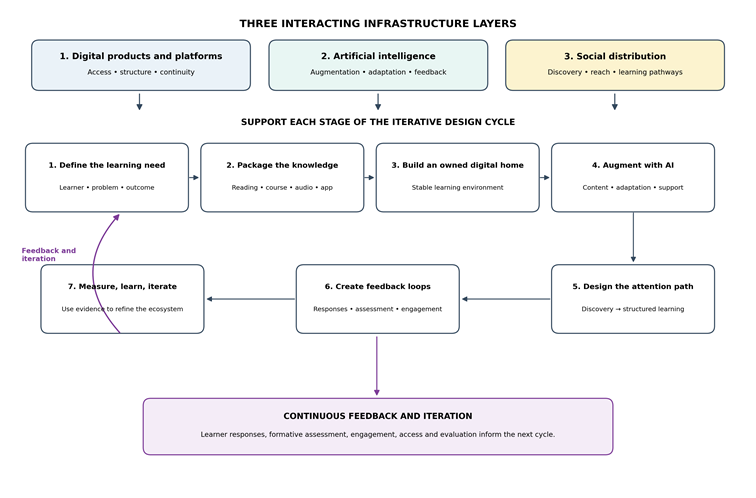
Figure 1: Integrated conceptual architecture showing the three infrastructure layers, seven-stage design cycle, and continuous feedback loop.
This structure distinguishes the proposed framework from a technology inventory. Each technology is assigned a function within a learning pathway. A mobile application, for example, is not valuable merely because it is mobile; its role is to increase access or continuity. AI is not included simply because it is available; its role is to reduce friction or support adaptation while preserving human judgement. Social media is not treated only as a promotional channel; its role is to create an entry point into structured learning.
3.4 Practical implementation examples
The Edify Hub ecosystem provides a practical illustration of how the proposed framework can be applied; it is presented here as an illustrative practitioner case, not as an independently evaluated empirical case study. Examples documented in the author's monograph include The Edify Hub Learning Institute as a digital learning environment, The Edify Hub mobile application for mobile access, structured online courses such as The Believer's Hand-book on Udemy, and The Edify Hub Podcast as a multimedia distribution channel. The author's published books and related digital publications also form part of this ecosystem. Together, these examples illustrate how knowledge products, learning infrastructure, mobile access, and multi-channel distribution can operate as connected components of an educational product ecosystem (Amabibi, 2026).
4. Discussion
The proposed framework is consistent with several established directions in educational technology research. First, the emphasis on adaptive learning and personalisation aligns with research mapping AI-enabled learning systems and identifying adaptive systems, intelligent mechanisms, and frameworks as recurring interventions (Kabudi et al., 2021). More recent review evidence similarly shows that AI-enabled adaptive education increasingly uses data-driven techniques to personalise learning experiences (Hariyanto et al., 2025). The contribution of the present framework is not another algorithm for personalisation; it is an ecosystem-level architecture that places adaptive functions alongside content, infrastructure, distribution, and feedback.
Second, the framework extends the digital ecosystem perspective. Rojas and Chiappe (2024) identify networks, applications, services, and users as important categories in educational digital ecosystems and note the relationship between AI and personalisation. The proposed model complements this view by adding an explicit product-development cycle. It asks not only what elements exist in the ecosystem, but what sequence of design decisions connects them to a learning need and how evidence is fed back into subsequent iterations.
Third, the role assigned to AI reflects the literature's emphasis on pedagogical and human considerations. Zawacki-Richter et al. (2019) identified adaptive systems, assessment, profiling, and intelligent tutoring among major AI application areas, while also highlighting the need for stronger theoretical and ethical connections. UNESCO (2023) likewise advocates a human-centred approach to generative AI, including attention to privacy, equity, safety, and meaningful pedagogical use. The framework therefore treats AI as an augmentation layer rather than as an autonomous substitute for educators or learner judgement.
Fourth, the feedback-loop component is supported by scholarship on AI and formative assessment. Zhai and Nehm (2023) discuss the potential of AI to support formative feedback and instructional decisions while emphasising the importance of understanding bias and developing appropriate practices. In the proposed framework, formative assessment is therefore not a final measurement step. It is part of the continuous product-learning loop through which evidence can inform the next interaction and subsequent design iteration.
Fifth, the attention-path component connects the framework to research on social media and educational engagement. Perez et al. (2023) found a large and growing body of work on social media in teaching and learning but highlighted the need for stronger theoretical grounding. Tarifa-Rodriguez et al. (2024) demonstrate that educational social-media engagement can be examined using behavioural measures. The proposed framework responds by treating social distribution as an entry layer whose success should ultimately be judged by its connection to meaningful learning activity rather than by visibility alone.
Ultimately, the proposed framework functions as an integration model rather than an empirically tested intervention. By explicitly connecting content, digital platforms, AI augmentation, and distribution into a cohesive architecture, the model offers a testable foundation from which future empirical research and learning outcome evaluations can be derived.
5. Conclusion
This paper developed a conceptual framework for educational product innovation in adaptive learning. The framework integrates three infrastructure layers, digital products and platforms, artificial intelligence, and social distribution, with seven design processes: defining the learning need, packaging knowledge, building an owned digital home, augmenting with AI, designing the attention path, creating feedback loops, and measuring, learning and iterating.
The framework responds to a gap between technology-specific approaches and the practical challenge of building coherent digital learning ecosystems. It positions AI within a broader learning architecture and gives explicit attention to distribution, feedback, and continuous improvement. The framework may therefore be useful to educators, learning designers, digital learning entrepreneurs, and organisations developing non-formal and technology-enhanced learning environments.
Several limitations should be noted. As a conceptual study, this work does not establish direct causal effects on learner achievement or retention. Furthermore, the synthesis is focused rather than systematic, and the practical examples rely on the author's documented implementations rather than independent external evaluations. Future research should address these limitations through empirical case studies, design-based research, and comparative evaluations addressing learner outcomes, privacy, equity, and AI reliability.
6. Acknowledgement for funding
No external funding was received for this study.
7. References
Amabibi, T. K. (2026). Educational product innovation: Engineering adaptive learning ecosystems through digital, AI, and social infrastructure. Zenodo. https://doi.org/10.5281/zenodo.22640880
Hariyanto, H., Kristianingsih, F. X. D., & Maharani, R. (2025). Artificial intelligence in adaptive education: A systematic review of techniques for personalized learning. Discover Education, 4, 458. https://doi.org/10.1007/s44217-025-00908-6
Kabudi, T., Pappas, I., & Olsen, D. H. (2021). AI-enabled adaptive learning systems: A systematic mapping of the literature. Computers and Education: Artificial Intelligence, 2, 100017. https://doi.org/10.1016/j.caeai.2021.100017
Perez, E., Manca, S., Fernández-Pascual, R., & Mc Guckin, C. (2023). A systematic review of social media as a teaching and learning tool in higher education: A theoretical grounding perspective. Education and Information Technologies, 28, 11921–11950. https://doi.org/10.1007/s10639-023-11647-2
Rojas, M. P., & Chiappe, A. (2024). Artificial intelligence and digital ecosystems in education: A review. Technology, Knowledge and Learning, 29, 2153–2170. https://doi.org/10.1007/s10758-024-09732-7
Tarifa-Rodriguez, A., Virues-Ortega, J., Perez-Bustamante Pereira, A., Calero-Elvira, A., & Cowie, S. (2024). Quantitative indices of student social media engagement in tertiary education: A systematic review and a taxonomy. Journal of Behavioral Education, 33, 769–797. https://doi.org/10.1007/s10864-023-09516-6
UNESCO. (2023). Guidance for generative AI in education and research. UNESCO. https://doi.org/10.54675/EWZM9535
Zawacki-Richter, O., Marín, V. I., Bond, M., & Gouverneur, F. (2019). Systematic review of research on artificial intelligence applications in higher education—Where are the educators? International Journal of Educational Technology in Higher Education, 16, 39. https://doi.org/10.1186/s41239-019-0171-0
Zhai, X., & Nehm, R. H. (2023). AI and formative assessment: The train has left the station. Journal of Research in Science Teaching, 60(6), 1390–1398. https://doi.org/10.1002/tea.21885
Selected Works and Practical Implementations
· The Edify Hub Learning Institute. (n.d.). About The Edify Hub Learning Institute. https://theedifyhublearning.org/about/
· The Edify Hub. (n.d.). The Edify Hub [Mobile app]. Google Play. https://play.google.com/store/apps/details?id=com.theedifyub.mobileapp
· Amabibi, T. K. The Believer's Hand-book [Online course]. Udemy. https://www.udemy.com/user/tonye-amabibi/
· Amabibi, T. K. The Edify Hub Podcast [Audio podcast]. Apple Podcasts. https://podcasts.apple.com/us/podcast/the-edify-hub-podcast/id1678154356
· Amabibi, T. K. Tonye Kehinde Amabibi: Author page. Amazon. https://amazon.com/author/tonyekehindeamabibi