An Experiential Learning Framework for Teacher Entrepreneurship Education
Giam Minh Nguyen1*
1 Faculty of Education, Thu Dau Mot University, Ho Chi Minh City, Viet Nam
*Corresponding author: giamnm@tdmu.edu.vn
Abstract. In the context of global education where entrepreneurship is regarded as a core competence, equipping future teachers with this capacity still lacks a specialized methodological framework. This study constructs an experiential learning framework for teacher entrepreneurship education to shift the training orientation from a narrow, commercial business-oriented approach to the development of a broad entrepreneurial mindset suitable for the educational context and the teaching profession.
The study employs a qualitative methodology based on systematic theoretical analysis-synthesis and conceptual modelling. It analyses and dialectically integrates three core theoretical pillars—David Kolb’s Experiential Learning Theory, the EntreComp/EntreCompEdu competence frameworks, and constructivist theory—to establish the principles of learning environment design and cycle operation.
The research findings propose an integrated Experiential Learning Framework for Teacher Entrepreneurship Education consisting of three organically linked components: (1) a constructivist experiential pedagogical learning environment; (2) an adaptive four-stage teacher entrepreneurship experiential cycle (comprising concrete pedagogical experience, pedagogical reflection, abstract conceptualisation of teaching principles, and active experimentation in entrepreneurial lesson design); and (3) defined competency outcomes for entrepreneurial pedagogy (incorporating an educational innovation mindset, facilitation of experiential learning, and risk management and resilience).
The study successfully addresses the theoretical gap regarding the development of specialized entrepreneurial competencies for pre-service teachers. The proposed framework provides a robust scientific tool to help teacher education institutions reform their curricula, equipping future educators with the necessary capacities to become active learning facilitators who lead educational innovation.
Keywords: Experiential learning; teacher education; pedagogical entrepreneurship; conceptual framework; educational innovation.
1. Introduction
Entrepreneurship education is currently regarded as a key solution for developing creative thinking and innovative capacity, as well as promoting active teaching and learning methods for learners (Athiende & Johnston, 2026; Sacramed, 2024; Zulkifli et al., 2025). However, equipping future teachers with this competence still faces numerous systematic difficulties on a global scale. In practice, entrepreneurship education in teacher training programmes in many countries has not yet received adequate attention or has been implemented inconsistently (Deveci & Seikkula-Leino, 2018; Stamatović & Zlatić, 2021). In Europe, only Estonia, Latvia, and Denmark mandate entrepreneurship education as a compulsory module for pre-service teachers (Trasberg, 2024), whereas in Serbia, the majority of teacher training institutions have not yet integrated this content into their curricula in any form (Stamatović & Zlatić, 2021). Furthermore, pre-service teachers face multiple barriers when implementing entrepreneurship education in their teaching practice, including rigid curricula (67%), limited time budgets (73%), low levels of self-efficacy, and a fear of failure when organising classroom activities (Otu, 2025; Ranta et al., 2022).
Addressing these challenges, this study aims to construct a theoretical framework for experiential learning pedagogy in entrepreneurship education for pre-service teachers. The proposed framework aims to reorient the training philosophy, shifting from a business-oriented entrepreneurial approach to developing a broad entrepreneurial mindset, which encompasses creativity, problem-solving, opportunity recognition, and flexible adaptation to practical changes (Arruti & Paños-Castro, 2020b; Athiende & Johnston, 2026; Trasberg, 2024). Through an experiential learning cycle combined with pedagogical reflection, the model enables pre-service teachers to play an active role in their learning process, experience firsthand, self-regulate, and progressively build their own teaching competence (Miço & Cungu, 2023; Rodrigues, 2023).
The prominent academic contribution of this study is that it enriches the theoretical foundation addressing the research gap in the development of specialized entrepreneurial competencies of pre-service teachers (Athiende & Johnston, 2026; Miço & Cungu, 2023). Rather than solely focusing on the content to be taught, the study delves into clarifying how entrepreneurial teaching and learning activities are organised within the pedagogical environment (Loi et al., 2022). On this basis, the study provides a theoretical framework to assist teacher education institutions in designing appropriate curricula, while supporting pre-service teachers in transitioning from the role of learners to entrepreneurial educators and learning facilitators, ready to drive educational innovation in future schools (Lepistö & Ronkko, 2013).
2. Research methodology
This study is conducted as a conceptual paper, employing a qualitative research methodology with two primary scientific reasoning methods: theoretical analysis-synthesis and conceptual modelling. The objective of the study is to construct a systematic and robust theoretical foundation to address the development of pedagogical entrepreneurship competence for future teachers.
2.1 Theoretical analysis and synthesis method
The theoretical analysis and synthesis method is used to analyse modern educational theories, thereby identifying connection points and complementarities to build an appropriate pedagogical foundation for entrepreneurship education. The study focuses on three main theoretical axes, including:
David Kolb’s Experiential Learning Theory (ELT) (1984): This theory views learning as a continuous process in which knowledge is created and developed through the transformation of real-world experiences. The learning cycle is analysed based on four stages: Concrete Experience (CE), Reflective Observation (RO), Abstract Conceptualization (AC), and Active Experimentation (AE). Furthermore, the study also examines Morris’s (2020) analyses regarding the role of experiential context and critical reflection to adapt Kolb's learning cycle to be more suitable for the teacher training environment.
The EntreComp and EntreCompEdu competency frameworks: The EntreComp framework defines entrepreneurship as a comprehensive competence consisting of three areas and 15 core competencies, aiming to create value for the community. On this basis, the study further cross-references the EntreCompEdu framework, a competence framework specifically designed for educators, comprising five areas and 17 competencies. Combining these two frameworks helps to clearly define the learning outcomes for entrepreneurial pedagogical competence for pre-service teachers.
Constructivism: Constructivism is utilized as the philosophical foundation for transitioning from a traditional teaching model to a student-centred model. In this learning environment, pre-service teachers actively construct knowledge and develop competencies through practical experience, collaborative learning, and peer exchange, while lecturers act as guides, supporters, and facilitators of the learning process.
2.2 Conceptual modelling method
Alongside the analysis of foundational theories, this study employs conceptual modelling to connect the theoretical foundations into a unified system. This approach stems from the fact that no single learning theory can fully explain the diversity and complexity of entrepreneurship education. The modelling process is implemented in three logical steps.
Step 1: Establishing the relationship between the constructivist learning environment as the philosophical foundation, Kolb’s adaptive experiential learning cycle as the competency development process, and the competency groups within the EntreComp and EntreCompEdu frameworks as the learning outcomes of the training programme.
Step 2: Constructing a conceptual diagram to describe and visualize the interactive relationship between lecturers, pre-service teachers, and the learning environment in a practical context.
Step 3: Establishing a competency development mechanism based on an iterative spiral cycle, enabling students to continuously experience, reflect, adjust, and refine their own pedagogical competence through each learning cycle.
3. Results
The results of the theoretical research have shaped the Experiential Learning Framework in Teacher Entrepreneurship Education. This is an integrated theoretical model constructed to address the gap in experiential teaching and learning methods specifically designed for teacher training. The theoretical framework comprises three closely interrelated and complementary components: (1) a pedagogical experience activation environment; (2) an adaptive four-stage teacher entrepreneurship experiential cycle; and (3) learning outcomes for entrepreneurial pedagogical competence.
To clarify how the theoretical components are interconnected and interact, the study constructs an integrated experiential learning framework for teacher entrepreneurship education (Figure 1). This conceptual framework not only describes the structure of the educational environment and competency outcomes, but also represents the dynamic competency development of pre-service teachers through an adaptive four-stage experiential cycle.
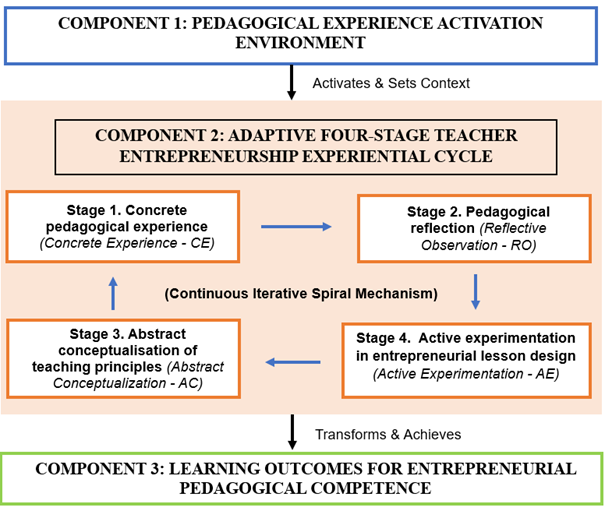
Figure 1. Conceptual Model of the Experiential Learning Framework for Teacher Entrepreneurship Education
Component 1: Pedagogical experience activation environment
The first component aims to construct a learning environment based on constructivism, in which pre-service teachers are no longer passive recipients of knowledge but become active subjects in the formation and development of their own competencies (Sioukas, 2023). This environment requires a transition from a narrow business-oriented approach, which primarily focuses on business creation and profit generation, to a broad entrepreneurial mindset, emphasizing creativity, opportunity recognition, and solving practical problems in education (Arruti & Paños-Castro, 2020b; Athiende & Johnston, 2026).
To foster the experiential process, the learning environment is designed with pedagogical makerspaces, interdisciplinary educational innovation projects, and simulation activities of school classroom contexts. In this environment, lecturers act as guides, mentors, and learning facilitators instead of merely transmitting knowledge (Chiromo et al., 2023; Lepistö & Ronkko, 2013). Through the integration of theoretical foundations, the study proposes an innovative learning environment model where entrepreneurial thinking and pedagogical thinking are connected, enabling future teachers to develop their capacity for action in practice.
Component 2: Adaptive four-stage teacher entrepreneurship experiential cycle
The second component is the core content of the theoretical framework, developed on the basis of adapting David Kolb's (1984) experiential learning cycle to fit the context of teacher training. The cycle is organised as an iterative spiral consisting of four closely linked stages.
Concrete pedagogical experience (Concrete Experience - CE): Students directly participate in designing and implementing non-commercial educational projects, such as developing EdTech digital teaching solutions, building projects to support disadvantaged students, or implementing initiatives to improve school activities.
Pedagogical reflection (Reflective Observation - RO): Following the experiential process, students conduct observations, write reflective journals, and engage in peer discussions to analyse difficulties, limitations, interactive situations, and lessons learned under a pedagogical lens (Morris, 2020; Rodrigues, 2023).
Abstract conceptualisation of teaching principles (Abstract Conceptualization - AC): From the reflective outcomes, students connect practical experiences with theories of education, psychology, and administration to formulate pedagogical principles suitable for their own contexts.
Active experimentation in entrepreneurial lesson design (Active Experimentation - AE): Students apply the established principles to design, conduct trial teaching, and facilitate lessons or entrepreneurship education activities for school students.
The adaptation of Kolb's learning cycle into a closed four-stage pedagogical practice process represents the theoretical contribution of this study. This approach assists students in transforming their entrepreneurial experiences into the capacity to organise and facilitate practical teaching and learning activities.
Table 1. Operation and interaction process in the adaptive four-stage teacher entrepreneurship experiential cycle
|
Adaptive Pedagogical Experiential Cycle Stage |
Active practical activities of pre-service teachers |
Facilitation and guidance roles of teacher educators |
Entrepreneurial pedagogical competence transformation outcomes |
|
1. Concrete pedagogical experience (Concrete Experience - CE) |
Directly participating, designing, and implementing non-commercial real-world educational projects (such as EdTech digital teaching solutions, support projects for disadvantaged students, or school improvement initiatives). |
Establishing the context, providing pedagogical makerspaces, and inspiring initial innovative ideas for pre-service teachers. |
Helping pre-service teachers overcome passive barriers, initially forming a practical action-oriented mindset, and identifying opportunities for innovation in education. |
|
2. Pedagogical reflection (Reflective Observation - RO) |
Writing personal reflective journals after the experience; participating in group discussions and peer feedback to deeply analyse practical difficulties, failures, and interactive situations under a pedagogical lens. |
Organising critical reflection activities; posing open-ended questions to guide pre-service teachers in objectively perceiving and evaluating the pedagogical barriers encountered. |
Awakening the habit of self-pedagogical reflection; transforming real-world failures into profound lessons; developing critical thinking competence. |
|
3. Abstract conceptualisation of teaching principles (Abstract Conceptualization - AC) |
Systematically connecting and cross-referencing practical reflection outcomes with theoretical frameworks of education, psychology, and school administration to formulate personal teaching principles. |
Accompanying and supporting pre-service teachers in systematising lessons; guiding methods of connecting practice with scientific theories and conceptualising theory. |
Constructing personal innovative pedagogical principles and philosophies; strengthening confidence and significantly enhancing teaching self-efficacy. |
|
4. Active experimentation in entrepreneurial lesson design (Active Experimentation - AE) |
Directly applying self-formulated pedagogical principles to design lesson plans, conduct trial teaching, and facilitate classes or entrepreneurship activities for school students. |
Conducting formative feedback; observing trial teaching sessions and providing constructive feedback for continuous student improvement. |
Finalising the capacity to organise practical experiential learning; mastering skills to flexibly cope with uncertainty and readiness for pedagogical innovation in classroom teaching. |
Component 3: Learning outcomes for entrepreneurial pedagogical competence
The final component defines learning outcomes through the integration and adaptation of the EntreComp and EntreCompEdu competency frameworks to suit the context of pre-service teacher training (Arruti et al., 2021). Based on the limitations regarding pre-service teachers' risk-taking capacity and proactivity identified in previous studies (Arruti & Paños-Castro, 2020a), the study proposes learning outcomes comprising three main competency groups.
Educational innovation mindset: The ability to overcome a fixed mindset, readiness to embrace new challenges, and proactivity in developing creative teaching methods and tools that go beyond traditional approaches (Toding et al., 2023).
Facilitation of experiential learning: The capacity to design and implement experiential learning projects, collaborate in teamwork, connect resources from businesses and the community, and support students in developing self-learning competence (Deveci & Seikkula-Leino, 2018).
Risk management and resilience: The capacity for confidence, self-efficacy, and the ability to respond to uncertain pedagogical situations, manage risks in the school environment, and persistently pursue educational innovation activities (Ranta et al., 2022).
Through systematising and clarifying the relationship between the competencies in EntreComp and the practical requirements of the teaching profession, the study has proposed a comprehensive system of learning outcomes for entrepreneurial pedagogical competence. This competency framework not only contributes to perfecting the theoretical foundation for teacher training but also provides a scientific basis for assessing the competence of future teachers.
Table 2. Integrated learning outcomes system of entrepreneurial pedagogical competence for pre-service teachers
|
Proposed competence group |
Component competence (Adapted from EntreComp and EntreCompEdu) |
Behavioral indicators / Specific pedagogical action indicators |
Pedagogical mindset orientation and transformation |
|
1. Educational innovation mindset |
Identifying educational opportunities. Creativity and innovation in teaching methods. Future-oriented thinking. |
Proactively identifying limitations of traditional classroom teaching methods and proposing creative alternatives. Demonstrating an open mindset, readiness to continuously improve and update lesson plans to enhance interaction and meet the practical needs of school students. |
A fundamental shift from a fixed mindset to a flexible, broad entrepreneurial mindset, ensuring that future teachers are always ready to embrace and experiment with new ideas in teaching. |
|
2. Facilitation of experiential learning |
Designing active learning activities. Collaborative teamwork in pedagogy. Mobilising community and business resources. |
Designing lesson plans based on real-world educational projects and action-oriented learning. Effectively facilitating group activities, playing the role of a guide and learning facilitator (facilitator) to support students in self-constructing knowledge; successfully connecting external resources to serve the lesson. |
Comprehensively developing practical pedagogical capacity, completely replacing one-way theoretical transmission with the establishment of active experiential learning environments for students. |
|
3. Risk management and resilience |
Managing classroom uncertainty. Persisting and staying steadfast in pursuing innovation. Pedagogical teaching self-efficacy (self-efficacy). |
Confidently responding to and flexibly handling pedagogical situations arising outside the lesson plan in a scientific manner. Embracing classroom risks, viewing temporary pedagogical failures as opportunities for deep reflection to continuously learn and self-regulate methods after each teaching session. |
Significantly enhancing the confidence and pedagogical self-efficacy of pre-service teachers before graduation, helping to minimise pressure and negative perceived costs when organising entrepreneurship teaching. |
4. Discussion
The results of constructing the constructivist learning environment model within the Experiential Learning Framework demonstrate alignment with the trend of entrepreneurship education innovation that has attracted significant international attention. Recent studies all emphasise the necessity of shifting from a traditional business-oriented entrepreneurship approach, which primarily focuses on business planning and enterprise creation, to a broader approach aimed at developing learners' creative thinking, problem-solving capacity, and adaptability (Arruti & Paños-Castro, 2020b; Athiende & Johnston, 2026; Trasberg, 2024). On this basis, the pedagogical experience activation environment proposed by this study operationalises this orientation through the establishment of innovative pedagogical makerspaces, where pre-service teachers directly participate in in-depth problem-solving within real-world educational contexts rather than merely accessing theoretical business knowledge. This approach contributes to reducing learners' anxiety when accessing non-pedagogical content (Deveci & Seikkula-Leino, 2018). The contribution of this study lies in constructing and clarifying a model of a constructivist learning space in entrepreneurship education where entrepreneurial thinking is transformed to fit the pedagogical context, assisting future teachers in aiming to create educational and social values rather than solely focusing on economic value. Alongside the direct physical environment, extending the experiential framework to digital and hybrid learning environments is a necessary direction to increase the flexibility and adaptability of the model. In practice, integrating virtual makerspaces and utilizing educational technology (EdTech) simulations help pre-service teachers simulate real-world teaching scenarios, thereby developing problem-solving and classroom risk management competencies in a safe environment prior to actual teaching practice.
Furthermore, teacher entrepreneurship education should not be confined solely to formal training programs, which have inherent limitations in terms of time and content. Developing non-formal professional development initiatives, such as workshops, pedagogical hackathons, and competency recognition through community-based micro-credentials, will create additional flexible learning options for students. These activities not only alleviate the time constraints of formal training programs but also foster a culture of sharing and interdisciplinary collaboration among pre-service teachers, school teachers, and educational technology experts, thereby contributing to the formation of a lifelong learning roadmap for future educators.
The four-stage pedagogical experiential cycle developed from Kolb’s (1984) model contributes to addressing a notable limitation in current entrepreneurship education, namely the lack of appropriate teaching and learning methods. Many training programmes still primarily focus on transmitting theoretical knowledge without enabling learners to experience and act (Loi et al., 2022; Zulkifli et al., 2025). In this study, the cycle is designed with activities such as writing reflective journals, peer feedback, and directly constructing entrepreneurial lessons, thereby realising the transition from passive instruction to active experiential learning (Miço & Cungu, 2023; Rodrigues, 2023). Simultaneously, this design also responds to the assertions of Morris (2020) that the traditional Kolb model remains limited in its engagement with practical contexts and the depth of reflective activities. Building upon and expanding prior research, this paper proposes a closed pedagogical process in which Kolb’s cognitive stages are transformed into concrete practical steps, helping future teachers convert personal experiences into the capacity to organise and facilitate practical teaching and learning activities.
The system of learning outcomes for entrepreneurial pedagogical competence, constructed on the basis of integrating the two competency frameworks EntreComp and EntreCompEdu, brings significant value to teacher training. This system aims to address the limitations identified in previous studies, such as low risk-taking capacity, a lack of proactivity, and low levels of teaching self-efficacy among pre-service teachers (Arruti & Paños-Castro, 2020a; Ranta et al., 2022). To effectively implement these learning outcomes, the study proposes integrating the theoretical framework under a multi-level educational ecosystem model, which includes the micro-level focusing on teacher professional development, the meso-level focusing on curriculum reform at teacher education institutions, and the macro-level focusing on perfecting policies and cultivating an appropriate educational culture (Hardie et al., 2023). This approach enables teacher education institutions to flexibly integrate entrepreneurship education into specialized teaching methodology modules without increasing curriculum overload (Athiende & Johnston, 2026; Deveci & Seikkula-Leino, 2018). The outstanding contribution of this study is the proposal of a feasible multi-level ecosystem integration pathway, while providing a foundation for training institutions and educational administrators to construct tools for guiding, assessing, and developing future teachers toward becoming active educational innovators rather than merely performing a knowledge transmission role.
5. Conclusion
This study has successfully achieved the objective of constructing a comprehensive and specialised experiential learning framework for teacher entrepreneurship education. The prominent contribution of this study is the integration of three important theoretical foundations, including Kolb's Experiential Learning Theory, the EntreComp/EntreCompEdu competence frameworks, and constructivist theory, aiming to address the methodological gap of how to teach entrepreneurship in teacher training. Through three main components—an innovative constructivist learning environment, a closed and adaptive four-stage pedagogical experiential cycle, and a system of learning outcomes for entrepreneurial pedagogical competence—the study has contributed to shifting the training orientation from a traditional business-model-oriented entrepreneurship approach to developing a more comprehensive educational innovation mindset. The proposed model not only provides a systematic theoretical framework but also carries practical value, assisting teacher education institutions in orienting experiential teaching and learning methods and better preparing the professional competencies of future teachers.
Despite making significant academic contributions, this study still has several limitations that should be considered. As a conceptual paper, the proposed experiential framework is primarily built on the basis of analysing and synthesising existing theories, and has not yet been empirically tested or evaluated on a large scale at teacher training institutions. Furthermore, the study has not fully analysed the influence of differences in cultural contexts and educational policies across countries, nor the level of resource readiness of individual training institutions. These are all factors that may affect the implementation viability and effectiveness of the model in practice.
To continuously refine the theoretical framework and enhance the application value of the model, the study proposes two development directions for the future.
First, the Experiential Learning Framework should be piloted in teacher training programmes through empirical studies, employing quantitative, qualitative, or mixed-methods approaches. This will help objectively evaluate the impact of the model on the confidence, creative thinking, and learning facilitation capacity of pre-service teachers.
Second, detailed evaluation toolkits need to be developed in alignment with the proposed system of learning outcomes for entrepreneurial pedagogical competence. These tools will assist training institutions and educational administrators in evaluating, guiding, and standardising the professional competencies of future teachers in a consistent and effective manner prior to graduation.
6. Acknowledgement for funding
This research received no specific grant from any funding agency in the public, commercial, or not-for-profit sectors.
7. References
Arruti, A., & Paños-Castro, J. (2020a). How do future primary education student teachers assess their entrepreneurship competences? An analysis of their self-perceptions. Journal of Entrepreneurship Education, 23(1), 1-13. https://www.abacademies.org/articles/how-do-future-primary-education-student-teachers-assess-their-entrepreneurship-competences-an-analysis-of-their-selfperceptions-8980.html.
Arruti A, Paños-Castro J (2020b), International entrepreneurship education for pre-service teachers: a longitudinal study. Education + Training, Vol. 62 No. 7-8 pp. 825–841. https://doi.org/10.1108/ET-04-2020-0098
Arruti, A., Morales, C., & Benitez, E. (2021). Entrepreneurship Competence in Pre-Service Teachers Training Degrees at Spanish Jesuit Universities: A Content Analysis Based on EntreComp and EntreCompEdu. Sustainability, 13(16), 8740. https://doi.org/10.3390/su13168740.
Athiende, J. O., & Johnston, S. L. (2026). A systematic review of the factors of entrepreneurial education in pre-service teacher education. Entrepreneurship Education and Pedagogy, 9(3), 416-449. https://journals.sagepub.com/doi/pdf/10.1177/25151274261433243.
Chiromo, S. J., Khosa, R. M., & Kalitanyi, V. (2023). Online entrepreneurship teaching and learning approaches: A South African conceptual perspective. Journal of Education (University of KwaZulu-Natal), (93), 163-180. https://www.scielo.org.za/pdf/jed/n93/09.pdf.
Deveci, I., & Seikkula-Leino, J. (2018). A Review of Entrepreneurship Education in Teacher Education. Malaysian Journal of Learning and Instruction, 15(1), 105-148. https://doi.org/10.32890/mjli2018.15.1.5.
Hardie, B., Highfield, C., & Lee, K. (2023). Attitudes and values of teachers and leaders towards entrepreneurship education. Research Papers in Education, 38(4), 690–714. https://doi.org/10.1080/02671522.2022.2028891.
Kolb, D. A. (1984). Experiential learning: Experience as the source of learning and development (Vol. 1, No. 1, pp. 270-289). Englewood Cliffs, NJ: Prentice-hall.
Lepistö, J., & Ronkko, M. L. (2013). Teacher students as future entrepreneurship educators and learning facilitators. Education+ Training, 55(7), 641-653. https://doi.org/10.1108/ET-05-2012-0055.
Loi, M., Fayolle, A., van Gelderen, M., Riot, E., Refai, D., Higgins, D., ... & Cavarretta, F. (2022). Entrepreneurship education at the crossroads: Challenging taken-for-granted assumptions and opening new perspectives. Journal of management inquiry, 31(2), 123-134. https://journals.sagepub.com/doi/10.1177/10564926211042222.
Miço, H., & Cungu, J. (2023). Entrepreneurship Education, a Challenging Learning Process towards Entrepreneurial Competence in Education. Administrative Sciences, 13(1), 22. https://doi.org/10.3390/admsci13010022.
Morris, T. H. (2020). Experiential learning – a systematic review and revision of Kolb’s model. Interactive Learning Environments, 28(8), 1064–1077. https://doi.org/10.1080/10494820.2019.1570279.
Otu, W. (2025). Balancing Entrepreneurial Traits with Teacher Education: A Phenomenological Study of Two Ghanaian Colleges of Education. International Journal of Educational Practices and Engineering (IJEPE), 2(5), 36-47. https://doi.org/10.70504/ijepe.v2i5.15548.
Ranta, M., Kruskopf, M., Kortesalmi, M., Kalmi, P., & Lonka, K. (2022). Entrepreneurship as a Neglected Pitfall in Future Finnish Teachers’ Readiness to Teach 21st Century Competencies and Financial Literacy: Expectancies, Values, and Capability. Education Sciences, 12(7), 463. https://doi.org/10.3390/educsci12070463.
Rodrigues, A. L. (2023). Entrepreneurship Education Pedagogical Approaches in Higher Education. Education Sciences, 13(9), 940. https://doi.org/10.3390/educsci13090940
Sacramed, M. T. (2024). Assessing Entrepreneurial Readiness in Teacher Education Graduates for Future Success. Social Science and Humanities Journal, 8(10), 5336-5342. https://doi.org/10.18535/sshj.v8i10.1313.
Sioukas, A. (2023). Constructivism and the student-centered entrepreneurship classroom: Learning avenues and challenges for US college students. Industry and Higher Education, 37(4), 473-484. https://doi.org/10.1177/09504222221135311.
Stamatović, J., & Zlatić, L. (2021). Entrepreneurship and the education of future teachers. Revija za elementarno izobraževanje, 14(1), 13-30. https://doi.org/10.18690/rei.14.1.13-30.2021.
Toding, M., Mädamürk, K., Venesaar, U., & Malleus, E. (2023). Teachers' mindset and attitudes towards learners and learning environment to support students' entrepreneurial attitudes in universities. The International Journal of Management Education, 21(1), 100769. https://doi.org/10.1016/j.ijme.2023.100769.
Trasberg, K. (2024). Empowering entrepreneurial competencies and mindset in teacher training. Acta Paedagogica Vilnensia, (52), 142-157. https://www.ceeol.com/search/article-detail?id=1328671.
Zulkifli, N., Suhairom, N., Wahid, N. H. A., & Saipudin, N. A. (2025). Fostering Entrepreneurial Mindsets in Teacher Trainees: A Study on Entrepreneurship Education for Future Educators. International Journal of Research and Innovation in Social Science, 9(4), 2454-6186. https://dx.doi.org/10.47772/IJRISS.2025.90400313.