Simulating political processes as an ongoing innovative strategy for developing civic skills in middle school students. Educational intervention study in the 7th grade
Cristina Iordache*
Teacher of Social Education at Secondary School No. 29 “Mihai Viteazul” Constanta and
Secondary School No. 28 “Dan Barbilian” Constanta, Romania
*Corresponding author: gikhristin@gmail.com
Abstract. The present research aims to evaluate the effectiveness of simulation-based teaching methods in the development of civic competencies and in increasing students engagement in the learning process within lower secondary education. The study focuses on seventh-grade students and explores the impact of electoral simulations, political campaigns and public debates on civic literacy, critical thinking and democratic participation.
The research employed a quasi-experimental design involving two parallel seventh-grade classes, comprising a total of 53 students. Quantitative methods included pre-tests, post-tests and systematic observation grids, while qualitative methods involved portfolios, reflective journals, peer assessment and self-assessment activities. A comparative analysis was conducted between the experimental group, which participated in simulation activities, and the control group, which followed traditional instructional approaches.
The implementation of simulation-based learning activities contributed to a better understanding of democratic processes, increased student motivation and improved communication and argumentation skills. Students involved in simulations demonstrated greater participation, enhanced critical thinking abilities and a more active engagement in civic-related tasks.
The study highlights the educational value of experiential learning strategies in fostering democratic culture and active citizenship. The findings support the integration of simulation methods into Social Education curricula as an effective means of connecting theoretical knowledge with real-life civic experiences. Simulation represents a valuable pedagogical tool capable of transforming students from passive recipients of information into active participants in the learning process. Through role-playing and experiential learning, students acquire meaningful civic competencies essential for democratic participation.
Keywords: Civic education; Simulation; Experiential learning; Democratic participation; Critical thinking; Active citizenship.
1. Introduction
Education for democratic citizenship is one of the priorities of contemporary educational systems, in the context of the challenges generated by globalization, disinformation and the decline in civic participation of young people (Council of Europe, 2018). In this context, the simple transmission of information about democratic institutions is no longer sufficient to form active and responsible citizens.
Current pedagogical literature highlights the importance of interactive and experiential strategies, which allow students to learn through direct participation and critical reflection (Cerghit, 2023), (Cucoș, 2022). The simulation of political processes offers an authentic framework for practicing democratic behaviors, facilitating the understanding of electoral mechanisms and the development of argumentation, negotiation and decision-making skills.
Starting from these premises, the present research aims to analyze the efficiency of the simulation of political processes as an innovative method of teaching the subject of Social Education at the secondary school level (Ministry of National Education, 2023).
1.1 Research goal and objectives
The general goal of the research was to evaluate the efficiency of didactic simulation methods in order to optimize the formation of civic competences (UNESCO, 2024) and increase the degree of involvement of seventh grade students in their own learning process.
To achieve this goal, the following objectives were formulated:
• assessment of the initial level of civic literacy and students' representations of electoral processes and democratic institutions;
• design and implementation of learning activities based on experiential simulations (electoral campaigns, debates and voting);
• comparative analysis of the progress of students in the experimental group and the control group in terms of the development of critical thinking and civic argumentation skills.
1.2 Research hypotheses
The general hypothesis of the research assumes that the systematic use of simulation within the Social Education discipline contributes to increasing intrinsic motivation for learning and facilitates the transfer of democratic concepts in authentic contexts (Joița, 2021).
The working hypotheses were the following:
• integrating simulation as an active method determines a superior understanding and retention of political concepts compared to traditional strategies;
• assuming social roles specific to the electoral process contributes to the development of relational skills and behavioral self-regulation;
• participating in simulation scenarios favors the development of critical thinking and more efficient identification of argumentation errors.
2. Research methodology
The research was conducted on a sample of 53 students from two parallel middle school classes: grade VII A (26 students) and grade VII C (27 students). The sample was heterogeneous in terms of academic performance and included students with different levels of preparation, as well as Ukrainian students with audience status.
The research design included two main methodological directions:
2.1 Pedagogical experiment
Quantitative and qualitative methods were used.
Quantitative methods included:
• pre-test and post-test;
• systematic observation grid of interactions;
• analysis of cohesion and isolation indices within groups.
Qualitative methods included:
• amelioration intervention;
• analysis of student portfolio;
• reflective journals;
• self-assessment and peer assessment.
2.2 Comparative method
The data obtained were analyzed comparatively by reporting the results of the experimental group to those of the control group. The interpretation of the results will be done by using histograms and frequency polygons.
3. Implementation of simulation activities
The teaching intervention consisted of organizing activities to simulate democratic processes, including:
• establishing fictitious political parties;
• developing electoral platforms;
• producing campaign materials;
• delivering electoral speeches;
• organizing public debates;
• conducting the voting process;
• analyzing the results and reflecting on the experience.
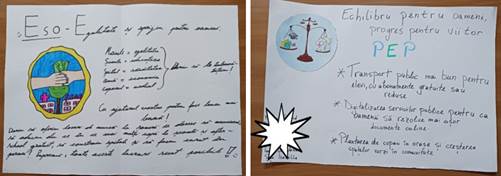
Figure 1. Campaign posters
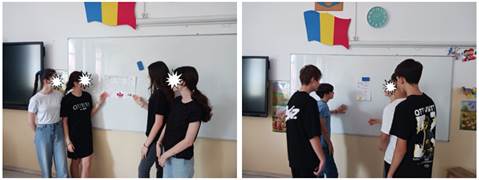
Figure 2. Speeches and platforms
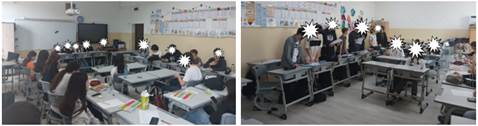
Figure 3. Debate
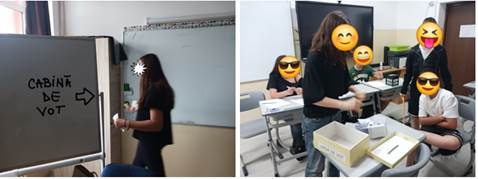
Figure 4. Polling station (left), Counting of votes (right)
Students had the opportunity to experience different social roles: candidate, voter, member of the electoral commission, journalist or debate moderator.
4. Results and discussion
The analysis of the obtained data highlights positive trends in terms of the development of civic competences of students involved in simulation activities. Compared to the control group, students in the experimental group showed an increased interest in civics, a more active participation in teaching activities and a superior capacity for argumentation. Also, systematic observations indicated the improvement of collaborative relationships and the reduction of passive behaviors within the experimental group. Portfolios and reflective journals highlighted the ability of students to make connections between the studied contents and real-life situations.
The preliminary results obtained largely confirm the hypotheses formulated at the beginning of the research and support the efficiency of simulation methods in teaching Social Education.
4.1 Preliminary results
Observations made during the implementation of the simulation activities indicate an increased receptivity of students towards the specific contents of civic and political education. Compared to activities based predominantly on expository methods, the simulation of electoral processes generated a higher level of involvement and active participation from students. During the electoral campaign and debate activities, students showed interest in assuming different social roles and demonstrated availability for collaboration, negotiation and expressing opinions in a democratic framework. An increase in self-confidence was also observed among students who, usually, participated less in frontal activities.
The analysis of the products produced to date (electoral platforms, speeches, campaign materials and individual reflections) highlights the ability of students to adequately use concepts such as democracy, representation, civic participation, rights and civic responsibilities. In addition, the arguments formulated during the debates suggest the progressive development of critical thinking and information evaluation skills.
4.2 Educational impact
Another effect noted is the improvement of the educational climate of the classroom. The simulation activities created authentic contexts of cooperation and favored interaction between students with different levels of school performance. The participation of Ukrainian students with audience status contributed to the consolidation of an inclusive environment and the development of intercultural competences of the entire collective.
From the perspective of motivation for learning, the feedback provided by students in the reflective discussions and self-assessments indicates that they perceive experiential activities as more attractive and relevant than traditional methods. Many students appreciated the opportunity to concretely experience democratic mechanisms and to understand the role of the citizen in a democratic society.
Although the research is still ongoing, preliminary results support the hypothesis that political simulation is an effective teaching strategy for developing civic and social skills in middle school students. Final data obtained through comparative analysis of pre-tests and post-tests will allow for rigorous validation of these initial observations.
5. Conclusion
The research demonstrates that simulating political processes is an innovative and effective teaching method for developing civic competences in middle school students. Experiential activities facilitate the understanding of democratic concepts, stimulate critical thinking, and contribute to increasing motivation for learning.
Due to its interdisciplinary and applicative nature, the proposed model can constitute an example of good educational practice, with real possibilities for expansion at the school and educational community level.
6. References
Cerghit, I. (2023). Teaching Methods. Bucharest: Polirom Publishing House.
Cucoș, C. (2022). Pedagogy. Iași: Polirom Publishing House.
Joița, E. (2021). Constructivist Teaching. Bucharest: EDP Didactic and Pedagogical Publishing House.
Ministry of National Education. (2023). School curriculum for the subject Social Education: Grade VII. Approved by Order of the Minister of National Education No. 3393/28 February 2017. Ministry of National Education. https://www.edu.ro/
UNESCO (2024). Global Citizenship Education Framework, https://unesdoc.unesco.org/ .
Council of Europe. (2018). Reference framework of competences for democratic culture (Vols. 1–3). Council of Europe Publishing. https://www.coe.int/en/web/reference-framework-of-competences-for-democratic-culture Edition 2023.