Sustainable Well-Being in Education
1“Stefan Procopiu” High School, Romania
*Corresponding author: tapetrei@yahoo.co.uk
Abstract. Sustainability is no longer a distant ideal but a responsibility that requires daily observation. It is shaping the way we live and develop, drawing our attention to the fact that we need balance in our rapid progress and ambitions.
Sustainability should begin in early education if we aim at building a future without exhausting not only what we already have, but also without borrowing from the next generations. Social equity and environmental care, two of the sustainability principles, need to connect with personal well-being in order to create a whole system allowing people to lead a satisfactory existence along with the planet.
Unfortunately, the educational systems are currently under pressure, students and teachers face increasing workloads, anxiety, emotional exhaustion, burnout. What education needs now is sustainable well-being: an approach that supports mental, emotional, physical, social, and environmental health for both students and educators. It is important to observe that sustainable well-being implies that students’ and teachers’ well-being are inseparable. A teacher that suffers from burnout cannot sustainably teach learners. In turn, overstressed students add emotional and disciplinary pressure on their educators. The system functions like in a chain reaction: when one part suffers, the whole is affected.
How can schools help people without exhausting them? This article explores what sustainable well-being means in educational settings, why it matters globally, and how students, teachers, and institutions can cultivate it together.
Keywords: Education for sustainability; Student well-being; Environmental awareness; Collaborative learning.
1. Introduction
Generally, in simple terms, well-being is understood as feeling good. Further, well-being is seen as a combination of good mental health, life satisfaction, a sense of meaning or purpose, together with the ability to manage stress. Sustainable well-being, however, has a deeper sense. It is not about permanent happiness or productivity, it is about resilience, balance, meaning, and continuity. “Sustainable wellbeing is achieved when improving individual wellbeing is correlated with improving the wellbeing of other members of society and the natural environment”, (Ronen & Kerret, 2020).
In education, there are three main pillars that support sustainable well-being: personal well-being that includes mental health, emotional regulation, physical vitality, and a sense of purpose, social well-being dealing with supportive relationships, inclusion, belonging, and healthy communication and environmental and systemic well-being including learning environments, institutional policies, and cultural norms that support human health (UNESCO, 2021).
Nowadays education has become a race for grades, exams scores, high-school or university admissions and employability and students are under performance pressure, which has serious consequences, such as mental and emotional challenges. Academic stress is amplified by social media that promotes comparison, while also tackling climate anxiety and economic instability as current topics. Students are afraid of failure and academic success often hides emotional struggle, difficulty of concentration, the feeling of not touching perfection.
Furthermore, teaching, as all the professions involving working with people, is particularly vulnerable and subjected to burnout (Cambridge Pathfinder, n.d.). Beyond lesson planning and grading, teachers manage emotional labour daily as they are involved in supporting students’ mental health, while adapting to constant policy and curriculum changes. Moreover, in many countries, teachers also face large class sizes, limited resources, job insecurity, and insufficient institutional support.
Taking these into account, sustainable wellbeing is significant as it connects mental health to environmental health, and personal habits to global outcomes (Lowe, I.,2010). It values resilience, connection, purpose, and ecological balance, which reminds us that living well and living responsibly are not opposites. Success needs to be redefined in learning environments where mistakes are considered part of the growing phenomenon, achievement values curiosity, reflection and rest are considered productive. Practices such as collaborative learning, outdoor education, and flexible assessment methods can reduce stress while improving engagement and retention. Moreover, when students are taught how to learn sustainably, they maintain those skills during adulthood, to the benefit of workplaces and communities. Real sustainability for educators includes reasonable workloads and clear boundaries, professional autonomy, access to mental health resources, time for collaboration, rest, and professional growth (Camilleri, M.A. & Camilleri, A.C. ,2020). Hence, when teachers are well, students feel it immediately and students who feel mentally and emotionally well are more engaged, motivated, and resilient.
Taking these into account, it is significant to look into the ways in which both students and teachers live the state of sustainable well-being. It is also significant to find sustainable approaches that create learning environments where everyone can develop in a balanced manner.
2. Research methodology
Sustainable well-being was conceptualized as the long-term maintenance of psychological, emotional, physical, and professional health among teachers and students. This article aims at examining sustainable well-being within educational contexts and is based on observations and discussions with students and teachers from public high-school in their daily activity, considering the balance between personal development/work engagement and stress levels. Analysing daily activity, we considered the factors that influence the sense of well-being in the educational environment, the practices that help maintaining well- being over time, the changes that make well-being more sustainable. To support daily activity observation, regular feedback and questionnaires were used to identify the causes that prevent sustainable well-being and suggestions for increasing well- being scores were asked. Also, the article presents the type of activities that along with teaching, create a proper environment for study.
The study was carried out on students in the first year of high-school, which is a period that requires rapid adaptation. The factors that contribute to stress among ninth-graders include assessment overload, competition, rigid schedules and, as a result, allowing a well-being culture will enable students to perform at their right potential. A first step is collaboration. Institutions that involve teachers and students in decision-making, that collect qualitative well-being feedback, treat well-being as an educational outcome, not as a side benefit will have immediate results (Twinkl., 2024). For example, giving students the opportunity to express their opinion, to make their voice heard, may lead to ideas for school life improvement. In this respect, students are encouraged to answer questionaries where they are asked about positive aspects, negative aspects of school life, things that they would keep or change, types of activities that they would enjoy. When sustainability education emphasizes problem-solving, collective action, creativity and innovation, students feel empowered rather than overwhelmed. The strategies for sustainable well-being include the development of self-awareness in what concerns stress and energy levels, the practice of reflective learning and the building of supportive peer groups (Mulberry Bush, n.d.). At curricular level, success needs to be defined beyond grades. With regard to teachers, they must set professional boundaries, seek collaboration and normalize rest as part of professional efficiency. Institutions should reduce academic overload and measure success by human outcomes, not just performance indicators. Most important, it is important to keep in mind that sustainable well-being is not achieved overnight, it is built through collaboration.
A second step, sustainable well-being in education is inseparable from environmental sustainability. The spaces where learning is in progress influence the way people feel and respond, and, as a result, comfort details such as large, airy classrooms, natural light, green spaces, fresh air, and safe, inclusive environments improve concentration emotional control. Students should be encouraged to participate in the classroom decoration and arrangement for various activities and at the same time should be motivated to organize activities themselves, such as exhibitions or talents shows. At the same time, outdoor learning, school gardens, and nature-based education not only improve mental health but also raise environmental awareness. In this respect, initiatives such as the “Project Week” or the “Green Week”, are not mere interruptions in the syllabus teaching but opportunities to develop creativity and value every student.
In order to benefit from optimum results, global perspectives on well-being should be studied. While the Nordic education systems emphasize balance, trust, and minimal homework, the Eastern ones rely on mindfulness, harmony, and collective well-being. For example, Finnish education integrates wellbeing into everyday school practices rather than treating it as an add-on programme. From balanced schedules that include regular breaks to empowered teachers with professional autonomy, the Finnish model demonstrates how wellbeing supports both academic excellence and personal development (EUNEO, 2025). It is true, however that the South-Eastern European region is characterized by some peculiarities and challenges (Andrei & Colomeischi, 2026).
As a teacher of English and form master of ninth -graders I observed that students need more and more time to establish cooperation links and to begin communication at school. They often isolate themselves, avoid others, keep silent in their desks during breaks and refuse contact with the new classmates. At the same time, private life means indulging in social media relaxation time and if the students are commuters, it is even harder to meet classmates after school, either for entertainment or for relaxation, in order to build a healthy social life. The fear of bullying, the lack of self- confidence and peer pressure have become serious drawbacks in school activity. Within this context, teachers are forced to obtain results. Teachers are under the pressure of going through the syllabus and focus on teaching the subject matter, in combination with the strive to catch up with the acquisitions and skills that were not perfected in the previous school years. High-school teachers have to complete gaps and push students forward overwhelmed with the burden of the soon -to-come final exams. Nevertheless, I consider that unless the class functions as a community of cooperating individuals, the goals of education are hard to be met. Consequently, I believe that the introduction of sustainable well-being strategies starting with the first day of school is the foundation of constant success. Here are some examples of activities, either as part of the English classes or as part of school projects, that broke the ice and brought together the class of ninth graders.
Reinventing the idea of the diary, students were encouraged to create a personal booklet in which they write, draw, stick pictures that reflect their hopes, dreams or desires. The booklet also contains their goals for diets and sports, the careers they would like to pursue, their imagination of the future and the description of their hobbies and leisure time. After busy periods or difficult days, following evaluation periods or after small success or failure, students work on a page of their booklet, thus restoring the calm necessary in the learning environment. The booklet is a helpful way of controlling negative emotions and indulging in positive ones, a way to bring students back to calm after an exciting or upsetting event.
Writing is beneficial when it comes to organizing oneself. An activity that may be performed during the English class is writing a letter to the “future you”, about dreams and goals. The student describes the actual achievements in life, what makes them happy, the hopes for the future. Then the letter is sealed and a future date to open it is decided. A similar activity may be performed at the end of the year, under the form of a list of resolutions for the new year. The teacher keeps the students’ resolutions a period of time and returns them to the students in order to reflect on the accomplishments made. Activities like these develop self -reflection and goal-setting, while, looking back at their own self in a time capsule triggers understanding, self- compassion and the need to care for oneself.
A fantastic way to bring students together and to encourage them to communicate is role play. Ninth graders benefit from extracurricular activities, such as projects on various topics, and among the first ones, those addressing bullying, violence or immediate school problems, are an opportunity to teach them how to react to unpleasant situations. By practising role plays tackling situations that they meet in real life, they feel more and more comfortable to express their feeling in a polite, sincere way and to encourage the others to communicate. They learn about different emotions and how to manage them. Understanding emotions such as happiness, sadness, anger, and anxiety helps building emotional resilience. Also, practising saying “no” when needing to set boundaries and learning to say “no” respectfully helps protect their time and emotional energy. Setting boundaries is an important skill for self-care and personal wellbeing.
Shy at first, students become more and more confident to perform either in front of the class or in pairs or small groups. Thus, the classroom becomes their own environment, where they are not stuck to their place in a desk but free to move and feel comfortable. Further to these activities, small talent shows are an opportunity to encourage each other, build confidence and teamwork and celebrate everyone’s performances.
Collaborative projects encourage liberty of expression and creativity. Collaborating on an art project, like large paintings using different techniques and styles give the sense of achievement and also results in a final product that is beautiful. Collaborative reading or social reading, popcorn reading, sequential reading, jigsaw reading give students the opportunity to express themselves freely, to develop their skills and talents. Creative story-telling sessions where each student contributes a new part to the story encourage creativity, active listening, and collaboration while creating a fun and imaginative group experience. Teamwork-based games that promote connection and fun such as trust falls, escape room challenges, or cooperative games, help build trust, communication, and problem-solving skills in a fun and engaging way.
3. Results
These activities were directed towards environmental awareness developing themes such as creating nature art, planting trees, spending time in the school garden, forest bathing or bird watching, listening to the sounds of nature and recording them, taking a moment of the day to appreciate nature, changing the diet for a day (eat organic, vegetarian or vegan). Students organized circular economy fairs at school where they exchanged books or clothes, workshops where they found new ways to make use of food scarps, recycle objects in the household, find new uses for broken items, make a plan for their household to collect garbage selectively. A change of scenery, like a lesson taken outside, social reading, recording a video, grew engagement, creativity, and, as a result, well-being.
To enhance social wellbeing, students made weekly or monthly schedules to eat and shop local food, organize neighbourhood clean-up, help local business, organize charity events for children or elderly people, animal shelters, organize donation activities for food banks, spend quality time with classmates. These activities aimed at improving relationships, and helping community. Students were guided in setting simple goals related to their mental or physical health, such as drinking more water, getting enough sleep, or practicing mindfulness. Setting and achieving goals helped building confidence and self-motivation.
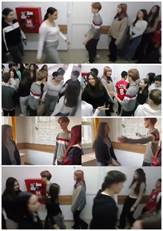
Figure 1. Practising greeting
Figure 1 - students are practising greeting each other as response to the teacher’s indication (express fury, disgust, love, surprise). All the students were involved and participated in the activity at the same time, acting as in real life situations
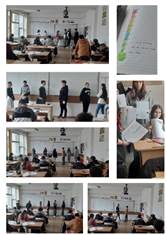
Figure 2. Performing in role plays
Figure 2 - students perform in role plays in which they practise answering bullying remarks, which helped building self-confidence.
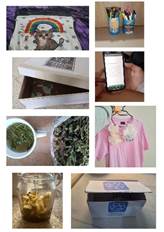
Figure 3. Applying the principle of sustainability
Figure 3 - students are applying the principle of sustainability in their households, creating recycling banks, putting into practice circular economy, acting environmentally friendly and enjoying periods of rest after periods of work.
4. Discussion
The activities described in this article illustrate how the concept of sustainable wellbeing can be meaningfully integrated into high-school education through reflective learning. Working with ninth-grade students proved particularly relevant, as this developmental stage is characterized by increasing autonomy, identity formation, and heightened sensitivity to social and environmental issues. The examples demonstrate that sustainable wellbeing is not an abstract or distant concept for adolescents, but one that can be explored through their everyday experiences, choices, and relationships.
A key observation across the activities was the strong interconnection students made between personal wellbeing and environmental and social sustainability. Students began to recognize the direct impact on their own quality of life. Activities of self-reflection, such as evaluating personal habits, were particularly effective, thus supporting existing research suggesting that wellbeing education gains depth and relevance when applied interdisciplinary.
Student engagement was enhanced by the fact that everybody had to participate. Collaborative discussions, creative tasks, and real-world problem-solving encouraged students to set their values and listen to differing perspectives. Such dialogue is essential for developing competencies such as critical thinking, empathy, which are associated with sustainable development.
A significant gain was the balance between activity and rest, digital work and traditional work, suggesting that sustainable wellbeing addresses adolescent challenges such as academic pressure or social comparison.
Nevertheless, such activities meet some limitations, among which time constraints and the need to observe the curriculum. But overall, the examples presented suggest that integrating sustainable wellbeing into ninth-grade education is possible, effective and valuable. When approached through interactive, age-appropriate activities, the concept can support not only students’ understanding of sustainability, but also their capacity to lead healthier, more reflective, and socially responsible lives.
5. Conclusions
Education shapes not only what people know, but how they live. If schools and universities teach achievement at the cost of health, they undermine their own purpose. If, however, they cultivate sustainable well-being, they become places where individuals and societies can truly flourish.
For students, sustainable well-being means learning with curiosity, resilience, and hope. For teachers, it means working with dignity, support, and joy. For the world, it means future generations equipped not just to survive complexity, but to shape it wisely.
In an era defined by rapid change, perhaps the most radical act education can take is this: to slow down enough to care — and to care deeply enough to last. Sustainable wellbeing is the intersection of personal wellbeing with social and environmental sustainability. By pursuing sustainable wellbeing, we can feel good about ourselves while taking care of the planet and community we live in!
6. References
Andrei, A.M., & Colomeischi, A.A. (2026). Wellbeing in European schools—Policies and recommendations: Peculiarities for the South-Eastern European region. In A. A. Colomeischi (Ed.), Wellbeing in schools of Southeastern Europe. Human Well-Being Research and Policy Making. Springer. https://doi.org/10.1007/978-3-032-10525-7_2
Cambridge Pathfinder. (n.d.). Well-being for teachers and learners. https://cambridgepathfinder.org/well-being-for-teachers-and-learners/
Camilleri, M.A. & Camilleri, A.C. (2020). The sustainable development goal on quality education. In S. Idowu, R. Schmidpeter, & L. Zu (Eds.), The future of the UN sustainable development goals. CSR, Sustainability, Ethics & Governance. Springer. https://doi.org/10.1007/978-3-030-21154-7_13
EUNEO. (2025). The role of wellbeing in education: The Finnish model. https://www.euneoscourses.eu/the-role-of-the-wellbeing-in-education-the-finnish-model/
Lowe, I. (2010). Education for a sustainable future. Journal of Chemical Education. American Chemical Society.
Mulberry Bush. (n.d.). 99 wellbeing activities. https://mulberrybush.org.uk/99-wellbeing-activities/
Ronen, T., & Kerret, D. (2020). Promoting sustainable wellbeing: Integrating positive psychology and environmental sustainability in education. International Journal of Environmental Research and Public Health. https://pmc.ncbi.nlm.nih.gov/articles/PMC7579264/
Twinkl. (2024). Twinkl’s extraordinary eight wellbeing activities for students. https://www.twinkl.com/blog/twinkls-extraordinary-eight-wellbeing-activities-for-students
UNESCO. (2021). Education for sustainable development: A roadmap for strengthening global action. UNESCO Publishing.