Use of multiple intelligences by role-play method
Adriana Grozavu1*
1Gymnasium School BP Hasdeu, No 12, Constanta, Romania
*Corresponding author: adrianagrozavu70@gmail.com
Abstract. Using the non-formal method of role-playing in a transdisciplinary format, combining history and French language, aimed to adapt teaching and learning methods to meet the need for lifelong learning skills development. The proposed objectives were: to train sustainable learning skills, develop competences for an interdisciplinary approach to the knowledge of history and French, and foster critical thinking, creativity, and text interpretation abilities.
A 5th-grade middle school class was selected, and the transdisciplinary history project was implemented under the theme The Gallic Wars: Asterix versus Julius Caesar, through the collaboration of history and French teachers. The project took place over six hours across both subjects. Students were divided into two camps - Gauls and Romans - chose their characters, conducted research on the historical events and key figures involved, and concluded with a role-playing activity simulating the final confrontation, performed in both Romanian and French.
Students expanded their knowledge of history and French by engaging in role-play and demonstrated their ability to communicate and collaborate effectively through teamwork. They successfully applied vocabulary and grammar elements and incorporated theatrical expression in the final presentation of the project.
Through this active method, role-playing, knowledge acquisition in both subjects was greatly facilitated, as it combined intellectual and physical aspects of learning. It helped students develop social and linguistic skills, improved their concentration, and enabled them to more easily assimilate prose elements and pronunciation in a contextualised setting. Furthermore, it supported vocabulary acquisition in both French and history and boosted students’ confidence in their ability to learn a foreign language.
Keywords: Role playing; Transdisciplinary; Multiple intelligences.
1. Introduction
Using the non-formal method of role-playing in a transdisciplinary format, combining history and French language, aimed to adapt teaching and learning methods to the need for lifelong learning skills development. The generations of children and adolescents currently in school will face future challenges that differ significantly from those for which they are traditionally prepared. For this reason, schools must foster lifelong learning skills in students (Iucu, 2008), aligned with the demands of the labour market and the changes in 21st-century society.
The emergence of new mass communication media, nanotechnologies, the exponential growth of technical information (doubling every 70 hours), and the continuous evolution of modern technology and science require the development of sustainable learning skills such as critical thinking, collaboration, interpersonal abilities, and problem-solving capacity. These competencies are closely linked to the concept of multiple intelligences, as introduced by Howard Gardner in 1983, which proposes nine distinct forms of intelligence.
The objectives of this project were: the development of sustainable learning skills; the acquisition of competencies for an interdisciplinary understanding of history and the French language; the enhancement of critical thinking, creativity, and text interpretation; and the integration of as many types of intelligence as possible (linguistic, logical-mathematical, visual-spatial, bodily-kinesthetic, interpersonal, and intrapersonal) in the learning process. The theory of multiple intelligences offers “new horizons” for exploring the necessary interactions between cognitive and socio-affective resources for effective learning, both formally and non-formally within school settings, as well as in extracurricular contexts, with many connections to the vast realm of informal education (Stoenică, 2021).
Focusing on skills development is a key aim of non-formal education, which is intended to complement traditional formal education in terms of objectives, content, and concrete methods of implementation. Teachers must adapt their instructional strategies to the levels and types of intelligence predominant among their students (Irimia, 2021). The choice of the role-playing method, as a non-formal strategy used innovatively in a transdisciplinary approach combining history and French, is designed to demonstrate that learning can be achieved through the integration of knowledge across subjects. This approach fosters the interdisciplinary understanding of history and French, the development of critical thinking and argumentation based on historical sources, and engages students in a playful activity through which each one develops their predominant type of intelligence (Manea, 2010).
2. Methodology
A method adapted to non-formal education is the role-playing method (Stein, 2017). It can be used both in the teaching process, as a form of student engagement to develop problem-solving skills, and as a form of assessment, since it integrates a variety of transdisciplinary competencies (Crișan et al, 1998). In this project, it was applied as an interactive, transdisciplinary learning experience combining French history and language.
The method draws on the use of theatre as a form of personal development and has been adapted here to illustrate the potential for developing sustainable learning skills across multiple domains. A fifth-grade class of 28 students was divided into three groups: Gauls, Romans, and a jury of nine students. The role-playing activity, derived from theatrical learning, followed several stages. First, the theme was selected — The Gallic Wars: Asterix and Caesar. Together with the French and history teachers, the students developed the play’s script. They chose their camp (Gaul or Roman), selected characters, and conducted research on the historical events and key figures involved.
The process culminated in a role-playing game, where students enacted the confrontation between Caesar and Asterix, performing in both Romanian and French. The jury group evaluated the historical and linguistic accuracy, creativity, and stage performance of both teams and individual participants.
The project was the result of close collaboration between the two subject teachers, who guided and supported the students throughout the documentation and preparation phases. The entire activity took place over six hours of class time.
3. Results
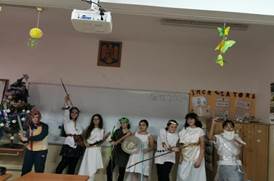
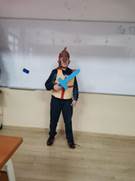
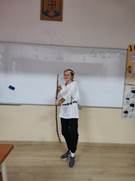
The implementation of the role-playing method allowed students to develop their knowledge of both history and French in a new and engaging context. Through teamwork during the documentation and preparation of scripts and costumes, students demonstrated collaboration skills, the ability to apply vocabulary and grammar, and the use of stage performance techniques during the final presentation.
 a)
a)
 b)
b)
 c)
c)
Fig 1. Role play, (a) Victory of the Romans, (b) Roman soldier, (c) Soldier of Gallia
Evaluation of the project was carried out directly, through oral feedback at the presentation, and indirectly, using a satisfaction questionnaire designed to assess student perceptions and learning outcomes.
The questionnaire included the following ten questions:
1. How do you rate the organisation of the role-playing activity? (Very good; Good; Satisfactory; Unsatisfactory)
2. Did you understand the tasks received during the role-playing activity? (Yes, completely; Partially; Not very; Not at all)
3. Do you think that the role-playing method helped you better understand the topic? (Yes, to a large extent; Partially; A little; Not at all)
4. Did the activity encourage you to participate actively? (Yes; Partially; Not very; No)
5. Did you collaborate effectively with the other participants during the role-playing activity? (Yes; Partially; No)
6. Did you feel that this method contributed to the development of the following skills? (Communication; Teamwork; Critical thinking; Empathy; Problem solving; Other)
7. What did you like most about the role-playing activity?
8. What do you think could be improved?
9. Name two pieces of information you learned from the activity.
10. Formulate a question based on the topic.
The aggregated responses shows that the application of the role-playing method yielded highly positive results across several dimensions of learning and student engagement. A large majority - 24 out of 28 students - rated the organisation of the activity as very good, demonstrating that the planning and structure of the project were well received. Regarding task comprehension, 20 students reported fully understanding the tasks assigned to them, while 4 indicated only partial understanding, and another 4 acknowledged difficulties in understanding, suggesting some room for improvement in clarifying instructions.
A striking outcome was that 26 students felt the method helped them better understand both the historical content and the French language elements integrated into the activity. All 28 students reported that they were actively involved throughout the project, highlighting the method’s success in fostering participation and engagement. Collaboration was also rated highly, with 22 students stating they collaborated effectively with their peers, although 6 students reported only partial collaboration, pointing to varying levels of teamwork experience among participants.
In terms of skill development, 18 students reported improvements in communication skills, 5 identified gains in critical thinking, and 3 noted enhancements in problem-solving abilities. This suggests that, while the majority benefited from communication practice, the activity also reached deeper cognitive and analytical skills for a smaller but notable portion of the group.
When asked about the most enjoyable aspects of the activity, 18 students emphasised the pleasure of dressing up and performing in the skit, while 9 particularly appreciated their roles in decision-making and acting as part of the jury. Suggestions for improvement included extending the use of this method to other subjects, allowing more time for preparation, and even developing the activity into a full-length theatrical play, indicating high levels of student enthusiasm and engagement.
The knowledge retained by students was diverse, ranging from detailed characteristics of historical figures and war strategies to the types of weapons used and the differing goals of the two camps — conquest for the Roman Empire and defence for the Gauls. The reflective questions formulated by students further demonstrated their critical engagement with the topic, addressing issues such as: Why did Julius Caesar want Gaul so much? Why didn’t the Gauls ally with other groups? Why didn’t they call on the Britons for help? Why didn’t they invent new weapons to secure their success? These reflections reveal not only content retention but also the development of analytical and evaluative thinking.
4. Discussion
These findings highlight that role-playing as a non-formal educational method not only increases student engagement but also contributes to the development of key transversal skills essential for 21st-century learning. The high levels of reported participation, collaboration, and enjoyment suggest that such methods can overcome barriers often encountered in traditional classrooms, such as student passivity or lack of motivation. Moreover, the diversity of knowledge retained and the reflective questions formulated by students demonstrate the potential of role-playing to foster critical thinking, creativity, and deeper cognitive processing. These results reinforce the argument that integrating multiple intelligences and active methods like role-play can create inclusive learning environments that respond to diverse student needs, preparing them more effectively for future educational and social challenges.
Even when applied in a transdisciplinary format, the role-playing method aligns with established pedagogical approaches as described in the specialised literature. Authors such as Căpiță Laura and Căpiță Carol in their work “Trends in History Didactics” (Căpiță & Căpiță, 2005), Pâinișoară Ion-Ovidiu in the paper “Effective Communication” (Panisoara & Duta, 2015), Bocoș Mușata-Dacia in her book “Interactive Instruction (Bocoș, 2013), and Cerghit Ioan in his book “Educational Methods” (Cerghit, 2006) highlight the value of role-playing for fostering active learning and skill development from primary to secondary school, across a variety of disciplines.
Specialised articles have further explored the adaptability and benefits of the method, underscoring its effectiveness in history lessons and beyond (UNATC, 2017).
Each adaptation of the role-playing method enriches the educational experience for both students and teachers, improving pedagogical approaches, developing key competencies, and transforming the teaching or assessment process into an engaging and instructive experience.
5. Conclusions
The application of the active method of role-playing has significantly facilitated knowledge acquisition in both history and French. By combining intellectual and physical dimensions, this approach helps students develop social and linguistic skills, enhances their ability to concentrate, and enables them to assimilate prose elements and pronunciation more easily in a contextualised manner. It also supports vocabulary acquisition in both French and history, fostering greater confidence in students’ ability to learn a foreign language (Ciofalca, 2017).
The advantages of correlating this non-formal method with the theory of multiple intelligences, as observed during the project, are multiple. Firstly, the student is recognised as an individual with unique characteristics, while the teacher gains insight into how each student learns and can assign suitable tasks to cover the syllabus effectively. Secondly, the approach enhances students’ self-esteem, as they become more motivated and confident by engaging the type of intelligence they master best. Thirdly, it actively engages all students, stimulating even those who are typically shy or reserved in peer interactions.
By combining these dimensions of human intelligence, the 21st-century student becomes equipped with the knowledge, competencies, and abilities - alongside the emotional resources - to creatively apply them and achieve success and performance in social life. The theory of multiple intelligences offers an alternative approach to differentiated instruction, serving as a modern, interactive educational strategy that can contribute to improving school performance. While all nine types of intelligence are distinct, they are equally valuable: no single type is more important than another. In today’s world, there are numerous examples of individuals who may not have excelled academically but have achieved outstanding success in business or other fields. Regardless of their strengths, individuals can amplify and develop their abilities within any type of intelligence.
6. References
Bocoș, M.D. (2013). Interactive Instruction, ISBN: 9789734632480, Polirom Publishing House.
Căpiță, L. & Căpiță, C. (2005). Trends in Teaching History, Pitești: Paralela 45 Publishing House.
Cerghit, I. (2006). Educational Methods, ISBN: 973-46-0175-X, Polirom Publishing House.
Ciofalca, M. (2017). Innovative teaching-learning methods for reducing drop-out. Publishing House of the Journal of Education.
Crișan, A., Cerkez, M., Oghină, D., Sarivan, L., & Tacea, F. (1998). National curriculum for compulsory education. Corint Publishing House.
Irimia, D.A. (2021). Valorificarea teoriei inteligențelor multiple în procesul de educație: Aplicații la disciplina istorie. Retrieved from https://iteach.ro/experientedidactice/valorificarea-teoriei-inteligentelor-multiple-in-procesul-de-educatie-aplicatii-la-disciplina-istorie.
Iucu, R. (2008). School training: Theoretical and applicative perspectives (2nd ed.). Polirom Publishing House.
Manea, M. (2010). Elements of didactics of history. In F. Adăscăliţei, M. D. Bercea, L. Lazăr, M. Manea, & M. Popescu, Elements of history teaching (pp. 7-10). Nomina Publishing House.
Panisoara, I.O. & Duta, N. (2015) The Effective Communication in Teaching. Diagnostic Study Regarding the Academic Learning Motivation to Students, Procedia - Social and Behavioral Sciences, 186(13), pp 1007-1012, DOI: https://doi.org/10.1016/J.SBSPRO.2015.04.064
Stein, M. (2017). Motivating, progressing: Methodological guide of non-formal methods and examples of good practices. Vremii Publishing House.
Stoenică, I.L. (2021). Emotional intelligence in the context of multiple intelligences. Studia Universitatis Moldaviae, Series Sciences of Education, 5(145), pp 127-131, DOI: http://doi.org/10.5281/zenodo.4889053
UNATC. (2017). Raport project: Methods of non-formal education, IMPRO TEEN. Bucharest. Retrieved from https://unatc.ro